Why Preventive Home Maintenance Is Easier Than Catch-Up Repairs
A home rarely develops a long repair list overnight. More often, maintenance problems begin as small, manageable issues: a loose cabinet handle, a small crack in the caulking, a door that starts sticking, or a section of trim that has become worn.
Because these problems do not always demand immediate attention, they can be easy to postpone.
One repair becomes three, then five, and eventually the homeowner is looking at a long list of unfinished maintenance tasks.
Preventive maintenance takes a different approach. Instead of waiting for several small issues to accumulate, homeowners can regularly inspect common wear points and deal with reasonable repairs while they are still straightforward to manage.
Preventive maintenance cannot eliminate every future repair, but it can make home upkeep more organized and predictable.
Small Problems Are Easier to Track When They Are Noticed Early
The first benefit of preventive maintenance is simply awareness.
A homeowner who regularly walks through the house is more likely to notice changes in doors, walls, trim, cabinets, finishes, and other frequently used areas.
That does not mean every small imperfection needs immediate attention.
Instead, noticing a problem gives the homeowner an opportunity to decide what it means. Is it normal wear? Does it affect how something works? Does it appear to be getting worse? Does it need professional assessment?
Without regular checks, small issues can remain unnoticed until they become more inconvenient.
A simple inspection every few months can help homeowners maintain a better understanding of the condition of their property.
Pay Attention to Common Wear Points
Some parts of a home naturally receive more wear than others.
Doors and hinges are used repeatedly. Cabinet hardware is opened and closed every day. Baseboards and trim can receive bumps from furniture and household activity. Caulking can deteriorate over time, particularly in areas exposed to moisture.
These are useful places to include in a routine maintenance review.
Look for loose hardware, changes in alignment, visible cracks, damaged finishes, or anything that no longer works as smoothly as it once did.
The objective is not to inspect every square inch of the house.
Focus on areas that experience frequent use or exposure and make note of anything that has changed.
Keep an Eye on Caulking and Finishes
Caulking is easy to overlook because it is usually a small part of a larger surface.
Over time, however, caulking can become cracked, separated, discoloured, or otherwise worn.
Homeowners should pay particular attention to areas where caulking helps seal surfaces around sinks, tubs, showers, windows, doors, or other locations where moisture may be present.
A deteriorated finish does not automatically mean there is serious damage underneath.
It does mean the area deserves attention rather than being ignored indefinitely.
The same principle applies to paint, trim, grout, and other finishes. Regularly noticing changes makes it easier to decide when routine maintenance is appropriate.
Treat Moisture Signs With Appropriate Attention
Moisture-related problems deserve a little more consideration than ordinary cosmetic wear.
A new stain on a ceiling, unexplained dampness, swelling around a surface, peeling finish, or repeated discolouration can have different causes.
Sometimes the visible issue is simply a finishing problem. In other situations, there may be a source of moisture that needs to be identified.
That is why covering a stain with paint without understanding why it appeared may not be the best approach.
Preventive maintenance is partly about knowing when a visible defect is something that can be monitored and when it should be investigated.
If the source of a moisture problem is unclear, homeowners should consider getting appropriate professional help rather than assuming the visible symptom tells the whole story.
Keep Doors, Cabinets and Hardware Working Properly
Functional maintenance is often easier to deal with when homeowners notice changes early.
A cabinet door that has started sitting unevenly may only need an adjustment. A loose handle may require straightforward attention. A door that rubs against its frame may have a relatively simple cause.
Again, the point is not to assume that every problem is minor.
If something is becoming increasingly difficult to operate, repeated force is usually not a good substitute for finding out why.
Keeping these items on a maintenance checklist can prevent them from becoming forgotten household inconveniences.
Look After Walls and Drywall Before the List Grows
Interior walls naturally collect marks and minor damage.
Furniture can leave dents, household activity can cause scuffs, and small impacts can damage drywall or trim.
One small imperfection is rarely a major concern.
The challenge comes when several repairs accumulate throughout the house.
A useful maintenance habit is to record wall and finishing issues as they appear and group similar work together.
Instead of repeatedly stopping to deal with one small mark, homeowners can plan several appropriate finishing tasks for the same maintenance session.
This can save preparation time and make the overall workload feel more manageable.
Create a Simple Seasonal Review
Seasonal changes provide a natural reminder to inspect the home.
In Ottawa, the transition between seasons can be a useful time to review areas exposed to changing temperatures and weather conditions.
After winter, homeowners may notice changes to exterior finishes, trim, doors, steps, railings, or other exposed areas.
Before winter, they may want to review visible exterior wear and complete appropriate maintenance or preparation.
The exact checklist depends on the home.
The important part is having a recurring point in the calendar when household maintenance receives some attention.
A seasonal review does not have to take an entire day. Even a short walkthrough can help identify issues that might otherwise remain unnoticed.
Keep a Maintenance Record
Preventive maintenance becomes easier when homeowners keep simple records.
A note on a phone or a basic spreadsheet can track what was noticed, what was repaired, and when the work was completed.
This can be particularly useful for recurring issues.
If the same problem appears repeatedly, the record provides a clearer history. It can also prevent homeowners from forgetting when certain maintenance tasks were last completed.
There is no need for a complicated system.
A few basic details are enough to turn household maintenance from something reactive into something more organized.
Group Small Jobs Together
One of the most practical advantages of preventive maintenance is the ability to group several small jobs.
A homeowner might notice a loose door handle in one room, damaged trim in another, and a few minor finishing issues elsewhere.
Individually, these tasks may seem too small to schedule.
Together, they form a reasonable maintenance list.
Grouping jobs by location or type of work can reduce repeated preparation and make it easier to decide how the work should be handled.
When routine fixes begin accumulating faster than a homeowner can realistically address them, reliable home repair support in Ottawa can also be a practical way to work through several maintenance tasks in an organized manner. reliable home repair support in Ottawa
The decision depends on the homeowner’s available time, tools, experience, and the nature of the repairs involved.
Know Which Tasks Should Not Be DIY Projects
Preventive maintenance does not mean homeowners should attempt every repair themselves.
Some tasks are reasonable for a homeowner who has the necessary skills and equipment.
Others involve specialized knowledge or safety considerations.
Electrical systems, gas-related work, structural modifications, complex plumbing, and certain other trades should be approached carefully and handled by appropriately qualified professionals where required.
The same applies when a homeowner discovers that a seemingly simple repair is connected to a larger issue.
Knowing the limits of a DIY project is part of responsible maintenance.
Watch for Recurring Problems
A recurring repair deserves more attention than a one-time imperfection.
If a particular door repeatedly becomes misaligned, the same section of trim keeps separating, or a wall repeatedly develops a similar defect, record the pattern.
The purpose is not to assume that something serious is happening.
It is to avoid repeatedly fixing the same visible symptom without considering whether there is another reason the problem continues.
A recurring maintenance issue may require a closer assessment to determine what is actually causing it.
Do Not Let Preventive Maintenance Become Over-Maintenance
There is also a balance to maintain.
Not every scratch, faded finish, or minor imperfection needs to be corrected immediately.
A practical maintenance system should distinguish between normal signs of use and issues that affect function, comfort, safety, or the condition of the property.
Otherwise, homeowners can end up creating unnecessary work for themselves.
Preventive maintenance works best when it is reasonable.
The goal is to notice changes, prioritize meaningful repairs, and keep routine upkeep from becoming overwhelming.
Build a Simple Maintenance Routine
A useful home-maintenance routine does not need to be complicated.
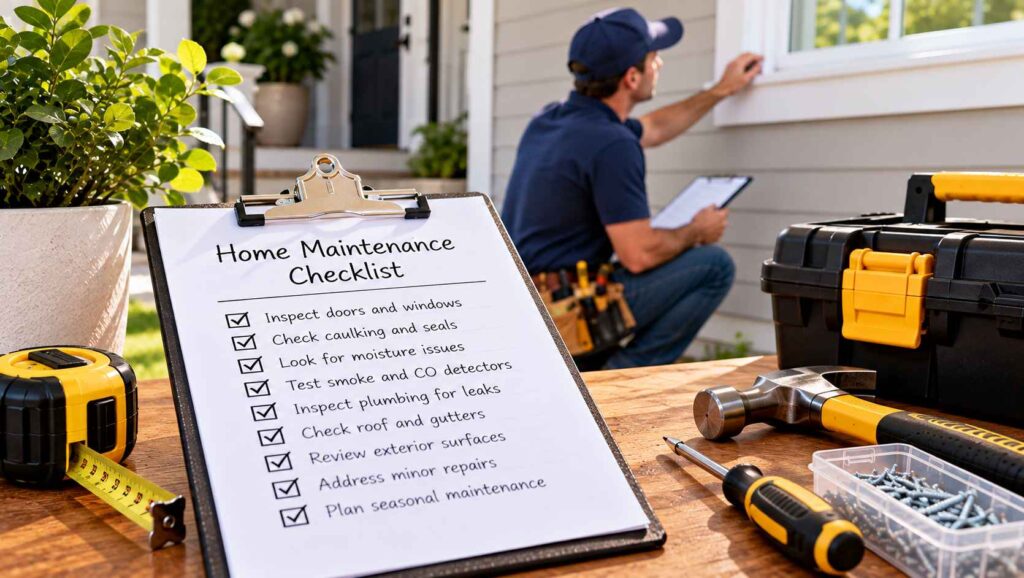
Every few months, walk through the property and look for changes.
Check frequently used doors and cabinets. Look at visible caulking and finishes. Pay attention to unexplained moisture signs. Review walls, trim, hardware, and areas affected by seasonal weather.
Record anything that needs attention.
Then divide the list into tasks that need prompt attention, jobs that can be scheduled, and cosmetic improvements that can wait.
This approach keeps the homeowner in control of the maintenance workload.
Make Home Upkeep More Predictable
Preventive maintenance is not about trying to make a home problem-free.
Every property experiences normal wear, and unexpected repairs will sometimes be necessary.
The advantage of regular maintenance is that it gives homeowners a better opportunity to notice changes before several unrelated problems accumulate.
A short seasonal review, a simple repair record, and a realistic priority system can make a significant difference to how manageable household maintenance feels.
Instead of waiting for a long list of neglected repairs to demand attention all at once, homeowners can address reasonable tasks gradually and make informed decisions about when to handle work themselves and when appropriate professional assistance makes more sense.
The result is not a perfectly maintained home at all times. It is a home where maintenance is visible, organized, and handled according to practical priorities.